Frequently Asked Questions
Find answers to common questions about our machine shop services, equipment, and processes.
The process is quite simple. It starts by sending whatever information you have on the part to the shop. The more information you have, the more streamline the process will be. An engineering drawing and 3D CAD model would be a great place to start, and will make the process much faster.
Once you are ready to submit a part, you can submit it by clicking the link. Once we receive the part request, we will send a quote to you as soon as possible. Once you approve on your end, we will send you an invoice for payment. With confirmation, we will then begin the manufacturing of your part.
The most preferred payment method is a transfer from Research Foundations funds internally in the CUNY system. If not applicable, we can accept credit card and ACH check transfers.
In the Centralized Machine Shop, we have:
- Manual mills and lathes
- CNC mills and lathes
- Waterjet cutter
- Injection molder
- Sand blaster
- Table saw
- Welder
- Laser cutter
- 3D printers
- Various other manufacturing equipment
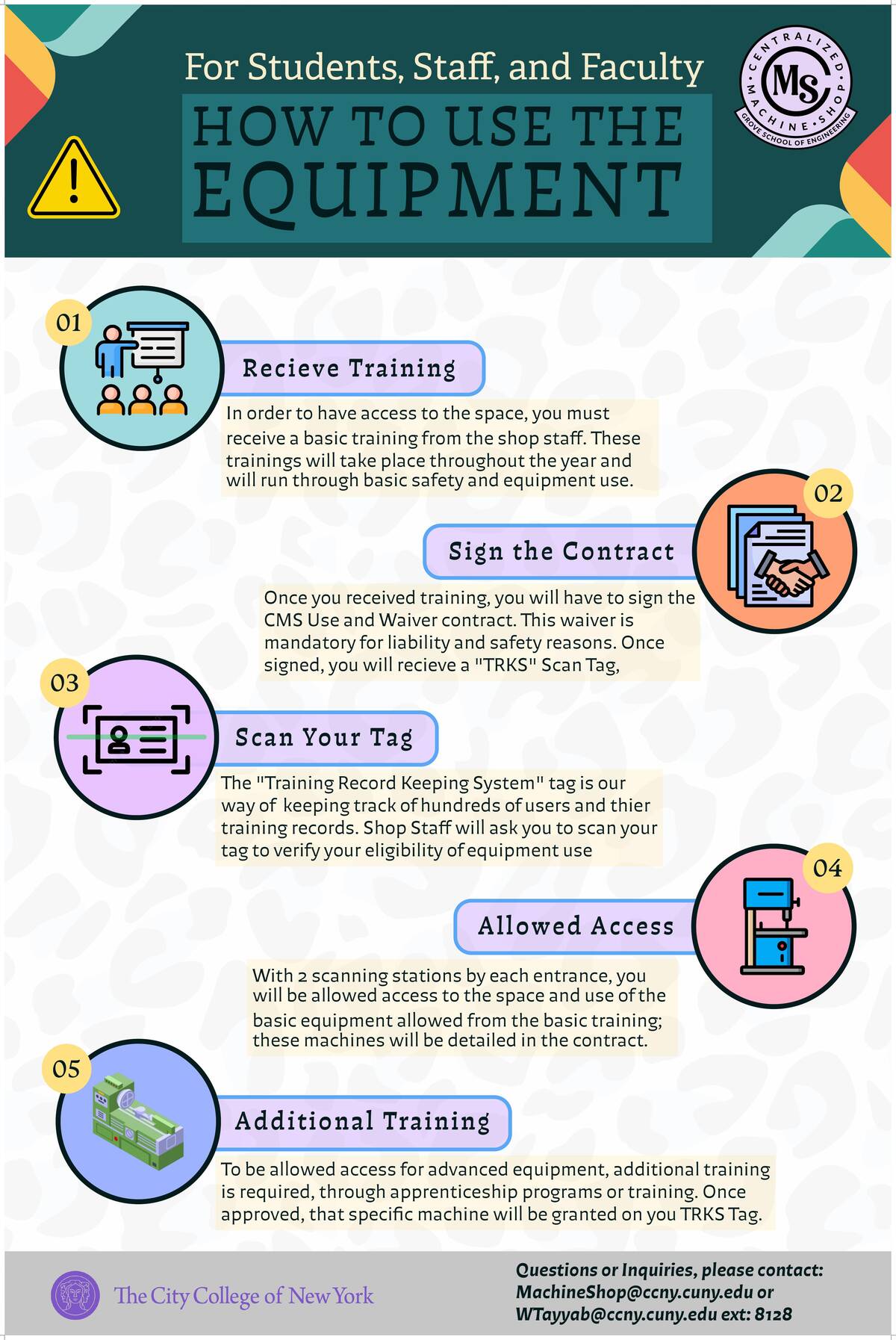
As a CCNY student, faculty, or staff, use of the equipment is at a per machine basis, meaning, depending on your training level of the specific machine, will determine your allowance of use.
You can, but you don't have to, we can also order the material on your behalf. In fact, it is preferred, so we can order based on the machine and workholding/fixturing we require.
The time frame depends on many factors, including complexity and quantity of your part. However, other factors also are taken into account, such as material and tool availability, and most importantly, there is a queue system of first-come-first-serve, which will determine which parts will be manufactured first.
In cases where timeline is crucial, there is an option on the form to choose for the part to be rushed or expedited.
Tolerances depend on the complexity of the part, as well as the form of manufacturing. Some basic idea of part tolerances would be .0001-.005 inches on machined parts, but will alter greatly depending on the method of manufacturing, which depends on the parts in question.
A good engineering drawing should include:
- Overall dimensions with tolerances
- Material specifications
- Surface finish requirements
- Critical and major dimensions clearly marked
- Assembly relationships if applicable
- Part name and number
- Scale information
- Revision history
- Title block with relevant information
The most preferred CAD software is SolidWorks, with the format of .SLDPRT. Although most CAD softwares can be saved as a .STEP file which can be opened by SolidWorks.
Still have questions?
Can't find the answer you're looking for? Please contact our team for assistance.
Contact Us